
Dr Safa
Clear aligner orthodontics
Doctor of Dental Surgery — University of Monastir · Certified in Infinity Aligner clear aligner systems
Over 900 aligner treatment plans supervised, with remote photo check-ins between stays.
Straighten your teeth without anyone noticing.

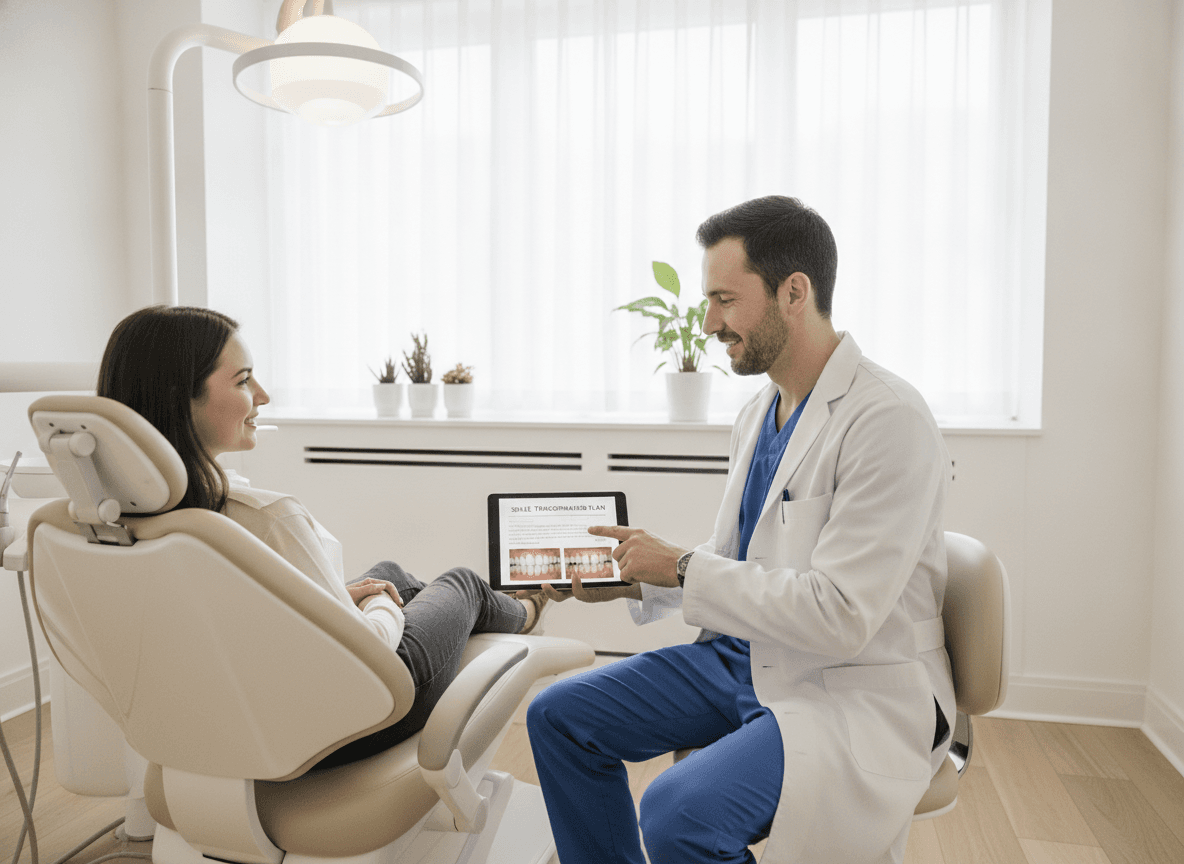
Clear aligners are custom, nearly invisible trays that gradually move the teeth to their ideal position. They replace conventional metal braces with a discreet, comfortable and removable solution.
Each set of aligners is made from a 3D treatment plan approved in advance: you see the final result before you even start. Monitoring is done remotely between stays — ideal for European patients.
Indicative price
€1,490
full treatment · depending on case complexity
Duration & stays
The plan is approved before you come. Wear averages 6 to 18 months depending on the case; trips to Tunisia are limited to short check-up stays, the rest is followed remotely.
Recovery & upkeep
After treatment, a retainer (tray or wire) keeps the teeth aligned. Regular nightly wear prevents any relapse.
Mild to moderate crowding of the teeth
Gaps between teeth to close
A slight jaw misalignment
Relapse after a former braces treatment
Digital impression and simulation of tooth movement. You approve the projected result before starting.
A custom series of aligners is produced, each moving the teeth a little further towards the goal.
Each aligner is worn 22 h/day, changed every 1 to 2 weeks. Removed to eat and brush your teeth.
Check-ups by photo/video between stays. A final retainer stabilises the result.

Our technology partner
Tunisia Smile works with a single clear-aligner brand — not for commercial exclusivity, but because it is the only one combining local manufacturing, certified medical-grade materials, and a genuine practitioner certification programme.
aligner treatment plans supervised by Dr Safa
cheaper than an equivalent treatment in Europe
aligners per treatment, depending on case complexity
Tunisian manufacturing, certified medical-grade materials
Your aligners are designed and produced in Tunisia. No customs, no intercontinental shipping between plan approval and receiving your series.
You deal directly with the team that designed your treatment plan — not a disconnected foreign call centre.
Dr Safa completed the Infinity Aligner certification programme. Every 3D plan is validated by her before manufacturing, not by an algorithm alone.
With no customs fees or international distributor margin, the price gap goes into your pocket — not into overseas structural costs.
A single practitioner, exclusively trained and certified on Infinity Aligner systems.
Clear aligner orthodontics
Doctor of Dental Surgery — University of Monastir · Certified in Infinity Aligner clear aligner systems
Over 900 aligner treatment plans supervised, with remote photo check-ins between stays.
The major aligner brands are solid. The difference comes down to manufacturing, follow-up, and final cost.
| Criterion | Infinity Aligner | International brands |
|---|---|---|
| Manufacturing location | Tunisia — local | Overseas, often outside Europe |
| Plan approval to aligners received | 2 to 6 days | ≈ 5 to 10 weeks |
| Clinical follow-up between visits | Tunisia Smile team, in your language | Generic support centre |
| Full treatment cost | €1,490 – €2,400 | €3,500 – €6,000 in Europe |
Working with a single brand isn't a constraint for our patients: it's the outcome of auditing several manufacturers, from which Infinity Aligner came out ahead on manufacturing, materials, and practitioner certification.
Going deeper
Most sites stop at "an invisible tray that straightens teeth". Here is what actually happens, in plain language but without oversimplifying.
The aligner applies a light but continuous force — around 0.25 to 0.6 newtons per tooth — transmitted across the whole face of the tooth by the rigid shell, rather than through a single anchor point the way a bonded bracket would.
This pressure compresses the periodontal ligament on one side of the tooth and stretches it on the other. On the pressure side, bone is gradually resorbed; on the tension side, it is rebuilt. The tooth "glides" through its bony socket over several weeks, never torn out or moved abruptly.
Each tray can only move a tooth by 0.15 to 0.33 mm before the contact between the plastic and the enamel becomes too loose to keep pushing effectively — which is exactly why trays are changed every 1 to 2 weeks rather than waiting for one tray to finish the whole movement.
An optical scan (intraoral scanner, no messy impressions) produces a virtual 3D model of your arches. Planning software then breaks the total movement — from starting position to the validated final position — into dozens of small intermediate steps, each corresponding to one tray in the series.
The practitioner validates and adjusts every step before manufacturing: which teeth move first, in what order, and with what sequencing to avoid two teeth interfering with each other mid-treatment.
You see the projected result before you even start — this isn't just a sales pitch: it's the reference document that lets you objectively check, visit after visit, whether treatment is progressing as planned.
Attachments are small composite bumps bonded onto certain teeth to give the aligner an extra grip point. They're essential for complex movements — rotating a round tooth, extruding a tooth — that shell pressure alone can't control. Discreet, they're removed at the end of treatment.
IPR (interproximal reduction) means very lightly polishing the enamel between certain teeth — 0.2 to 0.5 mm per contact point — to create the space needed for alignment when extraction isn't indicated. Done within these limits, it doesn't weaken the tooth or cause lasting sensitivity.
Neither is used by default: the 3D plan determines precisely, tooth by tooth, where they're needed — before the first tray is even manufactured.
The standard clinical protocol calls for 20 to 22 hours of wear per day. Below that threshold, the applied force doesn't have time to act on bone remodeling before the next tray change, and the movement planned for that stage doesn't fully happen.
On some trays, a blue wear indicator gradually fades under oral heat, letting the practitioner objectively check actual wear time — not just what the patient reports.
Repeated under-wear is the leading cause of the gap between the projected and the achieved result, far ahead of individual biology. It often forces remanufacturing of intermediate trays, which delays and sometimes raises the cost of treatment.
Simple translations — moving a tooth as a block — and closing spaces are where aligners excel: predictable, fast, with no particular technical complication.
Rotating round-section teeth (canines, premolars) and extrusions (pulling a tooth out of the bone) are mechanically harder to control with a plastic shell than with a bonded bracket. They systematically require attachments and more intermediate trays.
Significant jaw discrepancies (severe Class II or III) remain outside the scope of aligners used alone — which is exactly what the initial 3D scan is designed to catch, before any financial commitment.
The fibers of the periodontal ligament and gum tissue keep a genuine "memory" of the original position for several months after movement — it's this mechanism, not a lack of treatment rigor, that causes relapse if nothing holds the tooth in place.
Two options exist: a retention wire bonded discreetly behind the teeth (fixed, invisible, minimal upkeep) or a removable retainer tray, worn at night.
Full bone stabilization takes 9 to 12 months after movement ends — this is the period when relapse risk is highest, which is why disciplined retainer wear matters even once the result looks visually complete.
Everything in the open
The real timeline, your eligibility based on your case, and the real difficulty of each type of tooth movement. Nothing hidden behind a vague "it depends on the case".
What most quotes compress into "a few months of trays". Here is the detail, visit by visit.
| Phase | Duration | Where | What you experience |
|---|---|---|---|
| Remote assessment | 3 to 5 days | At home | Photos and a scan if available; you receive a quote and an indicative treatment plan |
| Optical scan & 3D plan approval | 5 to 8 days | On-site, then remote | Intraoral scan with no impressions, full movement simulation; you approve the projected result |
| Manufacturing the full series | 2 to 6 days | Infinity Aligner lab, Tunisia | Trays are produced, quality-checked by the practitioner before shipping |
| Wear & change | 4 to 18 months | At home | 20 to 22 hrs/day, changed every 1 to 2 weeks, remote photo check-ins between visits |
| Mid-treatment check-up | 2 to 4 days | Trip to Tunisia | Clinical check, refinement trays if an adjustment is needed |
| Retention | For life | At home | Bonded wire or night-time retainer, checkable with your regular dentist |
The exact number of trays and total duration depend on the initial complexity of the case — exactly what the 3D plan determines before any commitment.
Case by case, including when the answer is no. A clinic that says yes to everyone is not reading your file.
| Your situation | Aligner suitable? | What we actually do |
|---|---|---|
| Mild to moderate crowding | Yes | Standard treatment, often 4 to 8 months, 10 to 20 trays |
| Spacing / diastema | Yes | Progressive closure, sometimes combined with attachments |
| Slight jaw discrepancy (edge-to-edge bite) | Yes, with attachments | Inter-arch elastics added to the protocol if needed |
| Significant jaw discrepancy (severe Class II/III) | No, not with aligners alone | Referred to combined treatment or a fixed appliance, decided after a 3D scan |
| Round teeth needing rotation (canines, premolars) | Yes, with attachments | Dedicated attachments and extra trays to secure the rotation |
| Relapse after previous brace treatment | Yes | A common case, often faster than a first treatment |
None of these answers can be given from a photo. The 3D scan decides objectively, and we refer you in writing to a fixed appliance if that's the better option for you.
An aligner excels at certain movements and needs far more work for others. Here's which is which.
| Movement | Difficulty for the aligner | Technique used | Indicative timeline |
|---|---|---|---|
| Simple translation (bodily movement) | Easy | No additional technique | 4 to 8 weeks per phase |
| Space closure | Easy | Optimized sequencing in the 3D plan | 6 to 10 weeks |
| Rotating a round tooth | Hard | Dedicated attachment + intermediate trays | 8 to 14 weeks |
| Extrusion (pulling a tooth down) | Hard | Attachment, sometimes combined with IPR | 10 to 16 weeks |
| Arch expansion | Moderate | Progressive sequencing, mid-treatment check | 3 to 6 months |
It's this real, tooth-by-tooth difficulty that determines the number of trays and total duration — not a generic estimate given before any examination.
Almost. The trays are transparent and hug the teeth; up close or from afar, they go unnoticed in everyday life.